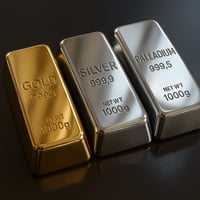
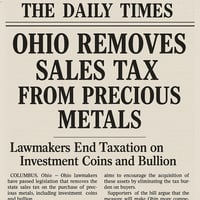
In June 2015, the Ohio House passed House Bill 26, aiming to exempt investment metal bullion and...
Minnesota Expands Precious-Metals Sales-Tax Exemption
The State of Minnesota is moving to reduce one of the largest practical barriers to owning and transacting in precious metals through House File 881 (HF 881), a bill that expands the state’s sales- and use-tax exemption to cover a much wider range of metal-based coins and currency.
While the proposal does not designate gold and silver as legal tender, it directly addresses the most immediate friction point for residents and businesses: transaction taxes.
What HF 881 Does
HF 881, which received updates through March 26, 2025, expands Minnesota’s existing exemption beyond bars and rounds to include:
- coins and currency made of precious metals,
- bullion in multiple physical forms (including bars, ingots, and commemorative medallions),
- multiple metals — gold, silver, platinum, palladium, rhodium, and combinations, and
- no minimum purity requirement, eliminating the prior 99.9 percent threshold.
This change has meaningful practical implications.
Minnesota’s base state sales tax is 6.875 percent, and local jurisdictions may add up to an additional one percent. On a $10,000 purchase of gold coins, the combined tax burden can exceed $687, a cost that does not apply to most other financial assets, such as stocks or bonds.
A Practical, Infrastructure-Focused Approach
Unlike legislation in some other states, HF 881 does not attempt to formally redefine gold and silver as legal tender.
Instead, Minnesota is focusing on removing operational barriers rather than making symbolic legal declarations.
From a market-adoption standpoint, tax treatment often plays a larger role than formal legal status. When transaction taxes are removed, metals can be acquired, rebalanced, and liquidated more efficiently within ordinary financial planning and business operations.
This approach prioritizes usability and economic neutrality rather than reclassification.
Why Removing the 99.9% Purity Requirement Matters
The elimination of the previous purity threshold is one of the most consequential changes in HF 881.
Under the former standard, many widely traded and historically important coins were excluded from the exemption, including:
- pre-1965 U.S. silver coins (90 percent silver),
- American Gold Eagles (91.67 percent gold),
- South African Krugerrands (91.67 percent gold), and
- many historical gold coins that are approximately 90 percent gold.
These coins have long served as core retail and savings instruments in the precious-metals market. HF 881 brings these commonly used products into the same tax treatment as high-purity bullion.
Competitive Pressure from Neighboring States
Minnesota’s surrounding region already offers more favorable tax treatment for precious metals.
For example:
- Iowa does not apply sales tax or state capital-gains tax to qualifying gold and silver,
- Wisconsin eliminated sales tax on precious metals in 2024,
- Michigan already exempts qualifying investment bullion and coins from sales tax, and
- South Dakota maintains one of the most favorable overall tax environments for precious-metals transactions.
This competitive imbalance has encouraged Minnesota buyers to make large purchases across state lines — shifting business activity, logistics, and associated economic spillover into neighboring states.
Fiscal Impact
State fiscal estimates indicate that HF 881 would reduce annual sales-tax revenue by approximately $2.2–$2.3 million.
However, experience in multiple states suggests that transaction taxes on precious metals often suppress in-state dealer activity, conventions, vaulting services, and associated professional services. In practice, states can lose more in displaced economic activity than they collect from the tax itself.
What the Bill Does Not Address
HF 881 is intentionally narrow in scope.
It does not:
- designate gold or silver as legal tender,
- remove state income or capital-gains taxation when metals are sold, or
- establish a state-run bullion depository.
Compared with broader reform packages in other states, Minnesota’s proposal focuses solely on eliminating sales-tax friction — arguably the most immediate and measurable barrier to participation.
The Broader Context
HF 881 fits into a wider national shift toward neutral tax treatment of precious metals.
As of early 2026, a large majority of U.S. states provide full or partial sales-tax exemptions for qualifying metals. Only a small group of states continue to apply full retail sales taxes to gold and silver transactions.
This trend reflects growing concerns about inflation, public-debt expansion, and the resilience of household savings in periods of monetary stress.
U.S. monetary policy is administered by the Federal Reserve, and prolonged currency depreciation has increased public interest in diversified and asset-backed stores of value.
Rather than promoting any specific payment system, HF 881 focuses on removing a state-level policy distortion that treats physical monetary assets differently from other forms of financial property.
What Happens Next
For HF 881 to become law, it must:
- advance through committee review,
- receive floor approval in both chambers of the Minnesota Legislature, and
- be signed by the governor.
Given the bipartisan adoption of similar tax reforms in neighboring states and the competitive pressure facing Minnesota dealers and investors, passage is plausible.
If enacted, HF 881 would significantly improve Minnesota’s competitiveness in precious-metals commerce — not by redefining money, but by removing a tax structure that places in-state buyers and businesses at a persistent disadvantage.