Many in our movement have been inspired by Kevin Freeman, a leading advocate for economic freedom. His groundbreaking book, Pirate Money: Discovering the Founders’ Hidden Plan for Economic Justice and Defeating the Great Reset, presents a compelling case for restoring gold and silver as true currency.
A Simple Solution for Economic Freedom
Freeman's insights reveal how gold and silver were central to the Founders' vision for financial stability. By promoting a return to Constitutional Currency, his work has galvanized efforts to create a more just and stable economic future.
Advancing the Cause of Constitutional Currency
Thanks to Freeman’s research and advocacy, we continue to champion strong, reliable money principles—empowering individuals, strengthening financial independence, and pushing back against economic injustice and instability.
FOR IMMEDIATE RELEASE Florida Finalizes Landmark Constitutional Money Framework, Clearing the Way for Gold and Silver Legal Tender Tallahassee, FL — Florida has finalized one of ...
FOR IMMEDIATE RELEASE Utah Advances Constitutional Money with Enactment of HB 195 Salt Lake City, UT — Utah has reaffirmed its commitment to restoring gold and silver to practical ...
FOR IMMEDIATE RELEASE Louisiana Establishes Nation's First State Certification Program for Gold- and Silver-Backed Payment Platforms Baton Rouge, LA — Louisiana has taken another ...
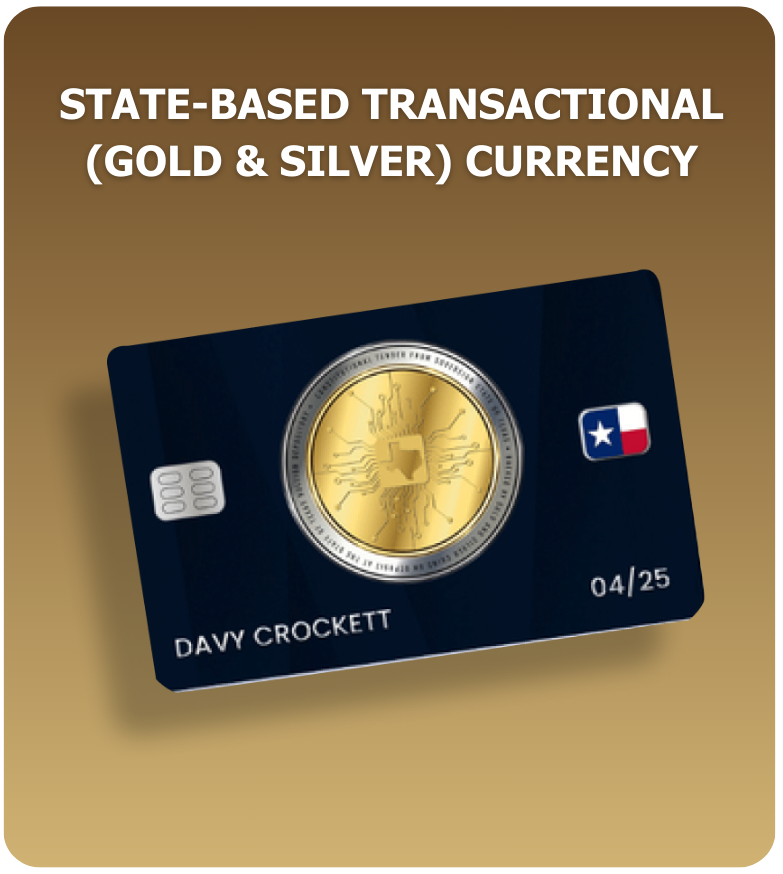
Transactional Gold and Silver (TGS) lets ordinary Americans own real, physical gold and silver and spend it like money. The metal is held in a secure vault within the United States, in your name, and a debit card or app lets you pay for everyday purchases while merchants receive ordinary U.S. dollars. TGS is state legislation that sets the rules; private companies provide the service. It is voluntary, and it is “Just Another Way to Pay.”
Because the dollar keeps buying less, and ordinary Americans have had no practical way to use gold and silver as everyday money. The U.S. dollar has lost approximately 90% of its purchasing power since 1971, while gold has held its value over time. Transactional Gold and Silver (TGS) is the law that connects the two through a debit card, making that protection official, safeguarded, and available to anyone, not just the wealthy.
You put dollars into a Transactional Gold and Silver (TGS) account, and the provider buys gold or silver for you, measured by weight, so you can start with a small amount. When you pay at the grocery store, the system calculates the exact fraction of gold or silver needed and converts it, and the merchant receives ordinary U.S. dollars. Nothing changes at the register, transactions are seamless and happen at the speed of society today. If you spend your gold, your gold balance simply goes down by the amount you spent.
Consumers and businesses benefit by having another easy to use payment system. Now gold and silver have easy liquidity and transactional capabilities. Transactional Gold and Silver (TGS) gives ordinary Americans another way to own and use gold and silver, starting with amounts as little as $5. Now, it’s easy to start saving gold and silver or spend it when needed.
Yes. Article I, Section 10 of the U.S. Constitution says no state may make anything but gold and silver coin a tender in payment of debts, and states can recognize gold and silver as legal tender under their own law. Transactional Gold and Silver (TGS) legislation builds on that foundation. The state sets the legal framework and safeguards, and authorized private providers deliver the service. (Note: The state does not buy the gold or silver, they do not become a bank or have to operate a vault.)
Is Transactional Gold and Silver a cryptocurrency?
No to both. Transactional Gold and Silver (TGS) is backed by real, physical gold and silver held in a vault in the United States, not by a digital token on a blockchain. It is not a central bank digital currency either: no central bank issues it, the government does not run the accounts, and nobody is required to use it. The card or app is simply modern payment technology for spending gold and silver you own.
Does Transactional Gold and Silver replace the U.S. dollar?
No. Transactional Gold and Silver (TGS) adds an option rather than taking one away. You can keep your bank account, cash, and cards, and merchants who accept a TGS payment still receive U.S. dollars. Participation is entirely voluntary for consumers, businesses, merchants, and financial institutions.
Which states have passed Transactional Gold and Silver laws?
Six states (Texas, Florida, Arkansas, Louisiana, Utah, and Missouri) have enacted Transactional Gold and Silver (TGS) laws, and more states are considering TGS bills.
Read the full answer → New answer, no article yet. Link to be added.