NORTH DAKOTA LEGISLATIVE BRANCH
Are you feeling the impact of inflation?
NORTH DAKOTA HAS THE ANSWER
It can happen with your support!
The Latest News...
North Dakota HB1441 sponsored by Rep. Nathan Toman recognizing gold and silver as legal tender has passed on the floor of the House and referred to the Senate Finance and Taxation committee for consideration. Rep SuAnn Olson gave compelling testimony in support of the bill at both committee hearings.
Rep Daniel Johnston has introduced bills HB1183 and HB1379. HB1183 allows for a portion of ND's rainy day fund to be invested in gold and silver. Additionally, HB1379 would remove capital gains tax on bullion.
|
North Dakota 2025 — at a glance |
|
|
Session dates |
North Dakota does not hold a regular session in even-numbered years. TGS-related bills moved during the 69th Legislative Assembly's 2025 regular session (January 7 – early May 2025). A three-day special session (January 21–23, 2026) addressed only the federal Rural Health Transformation Program and unrelated items — no TGS bill was introduced. |
|
Bills introduced |
HB 1441 (specie legal tender + CBDC exclusion) · HB 1183 (1% treasury gold/silver investment mandate) · HB 1184 (up to 10% Investment Board/Land Board precious-metals authority) · HB 1379 (capital gains exemption on bullion sales) |
|
Sponsors |
Rep. Nathan Toman, R-Mandan (HB 1441, HB 1184) · Rep. Daniel Johnston, R-Kathryn (HB 1183, HB 1379) |
|
Committee & floor progress |
All four bills cleared House committee and passed a House floor vote. HB 1441, HB 1183, and HB 1379 then failed on the Senate floor. HB 1184 failed outright in the House and never reached the Senate. |
|
Final status |
All four bills died in the 2025 session. None were revived in the January 2026 special session, whose call did not include TGS-related items. |
|
Key obstacle |
Senate skepticism about liquidity and fiscal mechanics — captured in Sen. Jerry Klein's floor remark that the treasurer is “just handling the checkbook” and gold/silver aren’t liquid enough for everyday state cash management. |
|
National significance |
Had HB 1441 passed the Senate, North Dakota would have become the sixth state to recognize gold and silver as legal tender. |
|
Note on scope |
None of the four 2025 bills would have established a bullion depository or debit-card payment rail — North Dakota's activity is earlier in the pipeline than states already debating depository/infrastructure bills. |
Recent News and Updates
North Dakota Senate Shuts Down HB 1441
North Dakota’s Growing Commitment to Transactional Gold
North Dakota House Passes Bill to Make Gold and Silver Legal ...
Key Resources
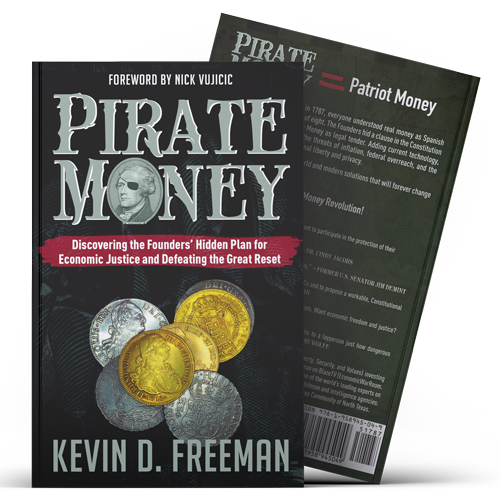
Pirate Money Book
The book is about money, the wealth gap, the Great Reset, Central Bank Digital Currency, and Chinese efforts to displace the American dollar. More importantly, though, it is about implementing a solution to provide Economic Justice for real people facing the severe challenges headed straight toward us all.
Buy Now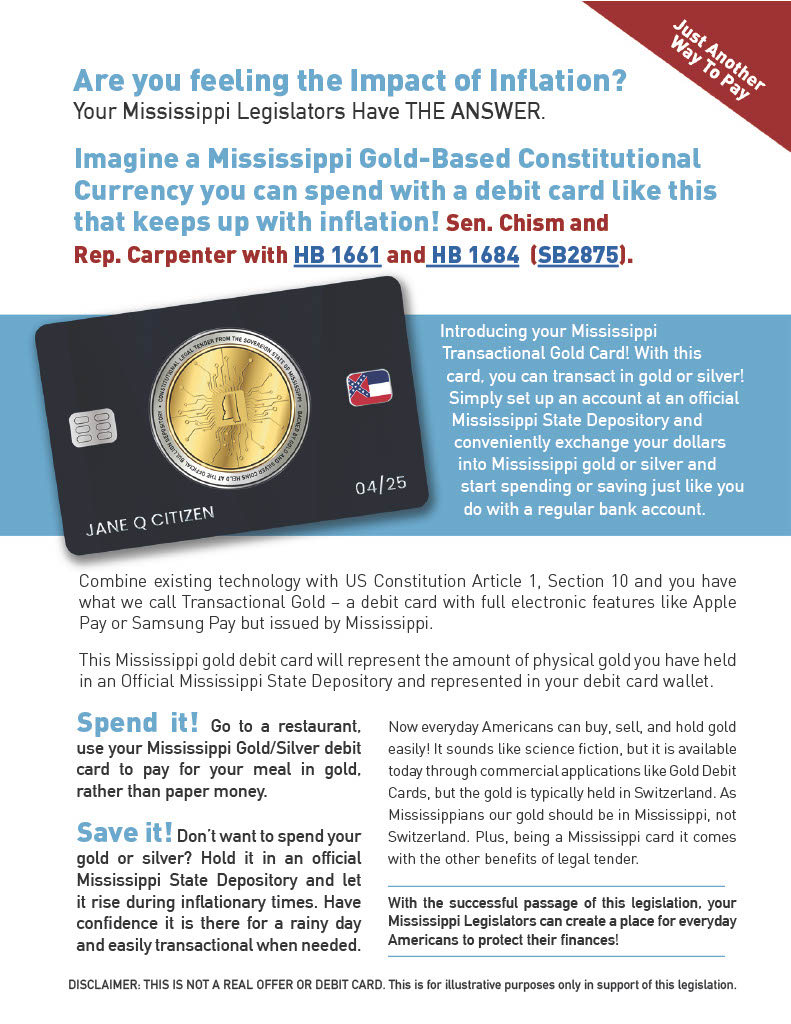
North Dakota Transactional Gold and Silver Flyer
Get the word out with our North Dakota customized flyer.
Download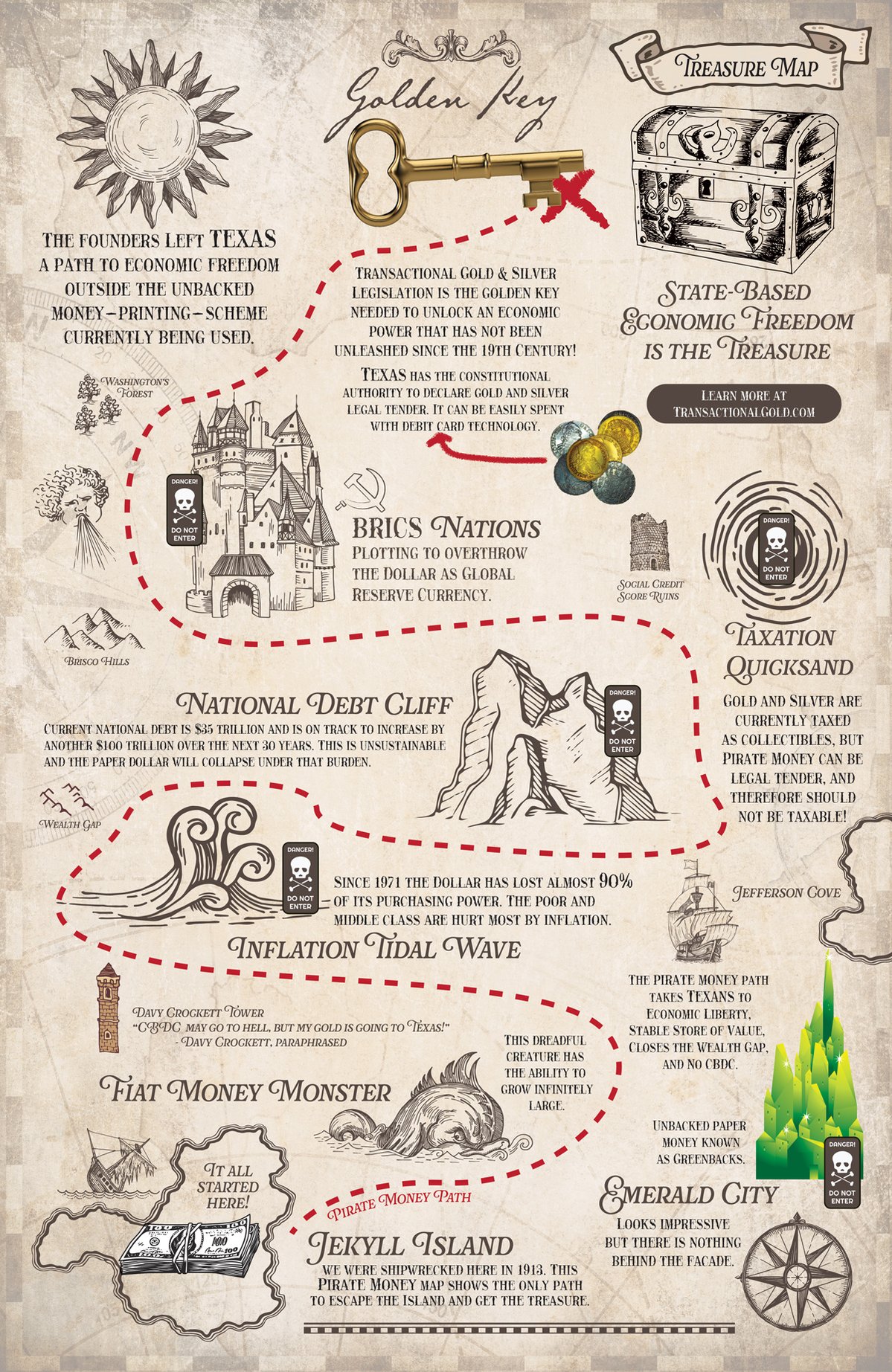
Pirate Money Treasure Map
This Treasure Map is an incredible tool for explaining the history of our monetary problem, and the Transactional Gold and Silver solution!
Download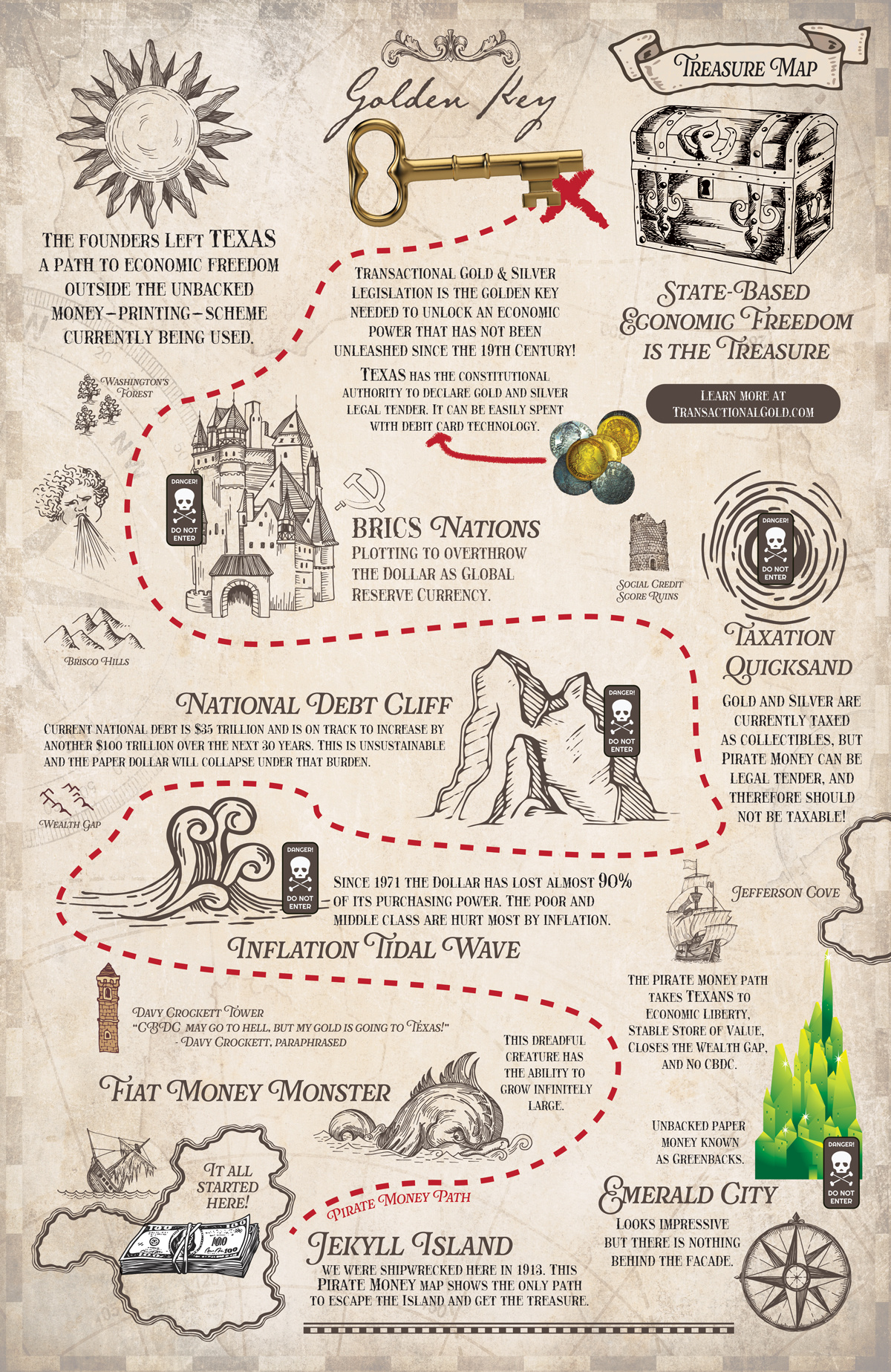
New to Transactional Gold and Silver? Start here.
The eight questions people ask first, answered in plain language. Each answer links to the full article in the TGS Answer Library.
“Just Another Way to Pay.”
What is Transactional Gold and Silver?
Transactional Gold and Silver (TGS) lets ordinary Americans own real, physical gold and silver and spend it like money. The metal is held in a secure vault within the United States, in your name, and a debit card or app lets you pay for everyday purchases while merchants receive ordinary U.S. dollars. TGS is state legislation that sets the rules; private companies provide the service. It is voluntary, and it is “Just Another Way to Pay.”
Read the full answer → transactionalgold.com/transactional-gold-faqs/what-is-transactional-gold-and-silver
Why do we need Transactional Gold and Silver?
Because the dollar keeps buying less, and ordinary Americans have had no practical way to use gold and silver as everyday money. The U.S. dollar has lost approximately 90% of its purchasing power since 1971, while gold has held its value over time. Transactional Gold and Silver (TGS) is the law that connects the two through a debit card, making that protection official, safeguarded, and available to anyone, not just the wealthy.
Read the full answer → transactionalgold.com/transactional-gold-faqs/why-do-we-need-transactional-gold-and-silver
How does it actually work? How do I spend gold?
You put dollars into a Transactional Gold and Silver (TGS) account, and the provider buys gold or silver for you, measured by weight, so you can start with a small amount. When you pay at the grocery store, the system calculates the exact fraction of gold or silver needed and converts it, and the merchant receives ordinary U.S. dollars. Nothing changes at the register, transactions are seamless and happen at the speed of society today. If you spend your gold, your gold balance simply goes down by the amount you spent.
Read the full answer → transactionalgold.com/transactional-gold-faqs/how-does-a-gold-and-silver-debit-card-work
Who benefits from Transactional Gold and Silver?
Consumers and businesses benefit by having another easy to use payment system. Now gold and silver have easy liquidity and transactional capabilities. Transactional Gold and Silver (TGS) gives ordinary Americans another way to own and use gold and silver, starting with amounts as little as $5. Now, it’s easy to start saving gold and silver or spend it when needed.
Read the full answer → transactionalgold.com/transactional-gold-faqs/who-benefits-from-transactional-gold-and-silver
Is Transactional Gold and Silver legal?
Yes. Article I, Section 10 of the U.S. Constitution says no state may make anything but gold and silver coin a tender in payment of debts, and states can recognize gold and silver as legal tender under their own law. Transactional Gold and Silver (TGS) legislation builds on that foundation. The state sets the legal framework and safeguards, and authorized private providers deliver the service. (Note: The state does not buy the gold or silver, they do not become a bank or have to operate a vault.)
Read the full answer → transactionalgold.com/transactional-gold-faqs/is-transactional-gold-and-silver-legal
Is Transactional Gold and Silver a cryptocurrency?
No to both. Transactional Gold and Silver (TGS) is backed by real, physical gold and silver held in a vault in the United States, not by a digital token on a blockchain. It is not a central bank digital currency either: no central bank issues it, the government does not run the accounts, and nobody is required to use it. The card or app is simply modern payment technology for spending gold and silver you own.
Read the full answer → transactionalgold.com/transactional-gold-faqs/is-transactional-gold-and-silver-cryptocurrency
Does Transactional Gold and Silver replace the U.S. dollar?
No. Transactional Gold and Silver (TGS) adds an option rather than taking one away. You can keep your bank account, cash, and cards, and merchants who accept a TGS payment still receive U.S. dollars. Participation is entirely voluntary for consumers, businesses, merchants, and financial institutions.
Read the full answer → transactionalgold.com/transactional-gold-faqs/is-transactional-gold-and-silver-trying-to-replace-the-dollar
Which states have passed Transactional Gold and Silver laws?
Six states (Texas, Florida, Arkansas, Louisiana, Utah, and Missouri) have enacted Transactional Gold and Silver (TGS) laws, and more states are considering TGS bills.
Read the full answer → New answer, no article yet. Link to be added.
Stay in the Know
Sign up to stay up to date on the latest news in your state.