
CONNECTICUT GENERAL ASSEMBLY
Are you feeling the impact of inflation?
CONNECTICUT HAS THE ANSWER
It can happen with your support!

The Latest News...
|
Connecticut 2026 — at a glance |
|
|
Session dates |
February 4 – May 6, 2026 (adjourned sine die) |
|
Bills introduced in 2026 |
No 2026 Connecticut bill establishing gold or silver as legal tender, creating a bullion depository, or establishing a gold-and-silver payment rail was identified in the Connecticut General Assembly legislative record or the major bill-tracking databases reviewed. |
|
Prior-session vehicle |
SB 1552 (2025) — “An Act Promoting the Ownership and Use of Gold and Silver in the State and Establishing the Connecticut Bullion Depository and the Gold Start Savings Program” |
|
Sponsor of record |
Filed by the Finance, Revenue and Bonding Committee (Joint); no individual legislator sponsor listed in the official bill record |
|
Committee progress (2025) |
Public hearing held April 14, 2025 before the Finance, Revenue and Bonding Committee; approved a committee substitute 52–0 on April 24, 2025 (File No. 853 printed and placed on the calendar May 8, 2025), with the legal tender, depository, and Gold Start Savings provisions removed |
|
Final status |
After the Finance Committee passed the substitute 52–0 on April 24, 2025, SB 1552 died on the Senate calendar when the session ended June 4, 2025. Its surviving pieces — a working group and a tax exemption expansion — were carried into law separately through the budget bill (Public Act 25-168, §§443–444). |
|
Key obstacle |
No bullion depository or legal tender framework has ever reached a floor vote in Connecticut. 2026 saw no attempt filed to revive one. |
Recent News and Updates
Iowa Eyes Transactional Gold and Silver
Iowa Bill passes through the House
Iowa study bill aimed at establishing a bullion depository
Key Resources

Pirate Money Book
The book is about money, the wealth gap, the Great Reset, Central Bank Digital Currency, and Chinese efforts to displace the American dollar. More importantly, though, it is about implementing a solution to provide Economic Justice for real people facing the severe challenges headed straight toward us all.
Buy Now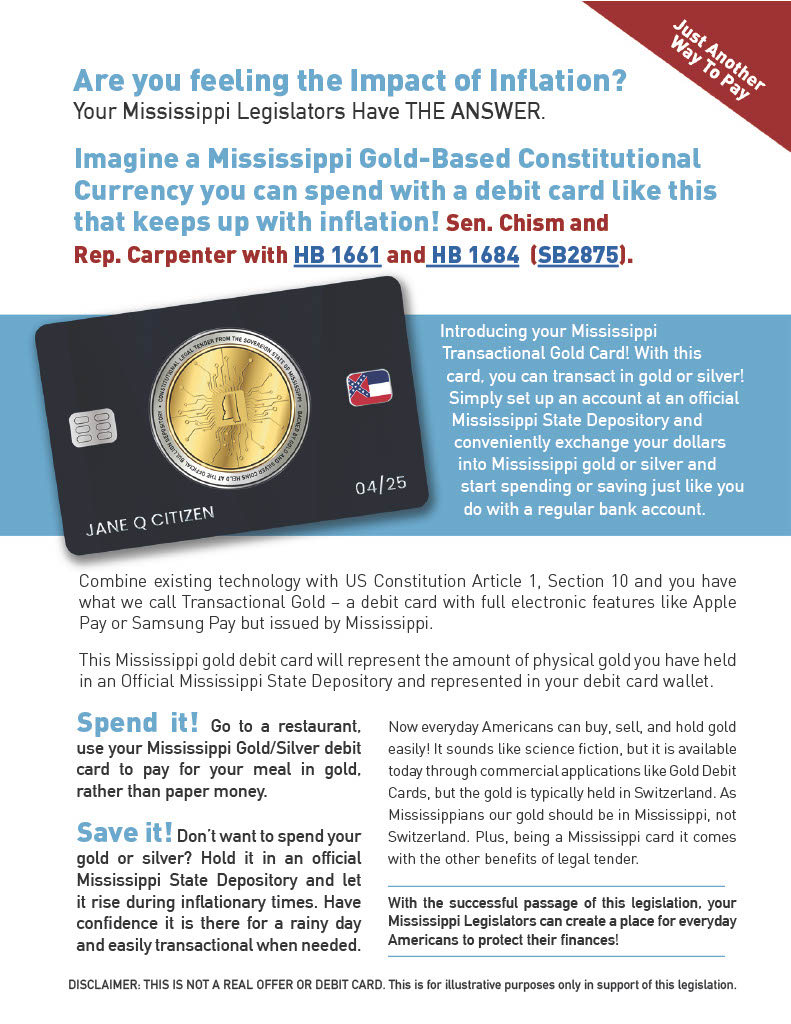
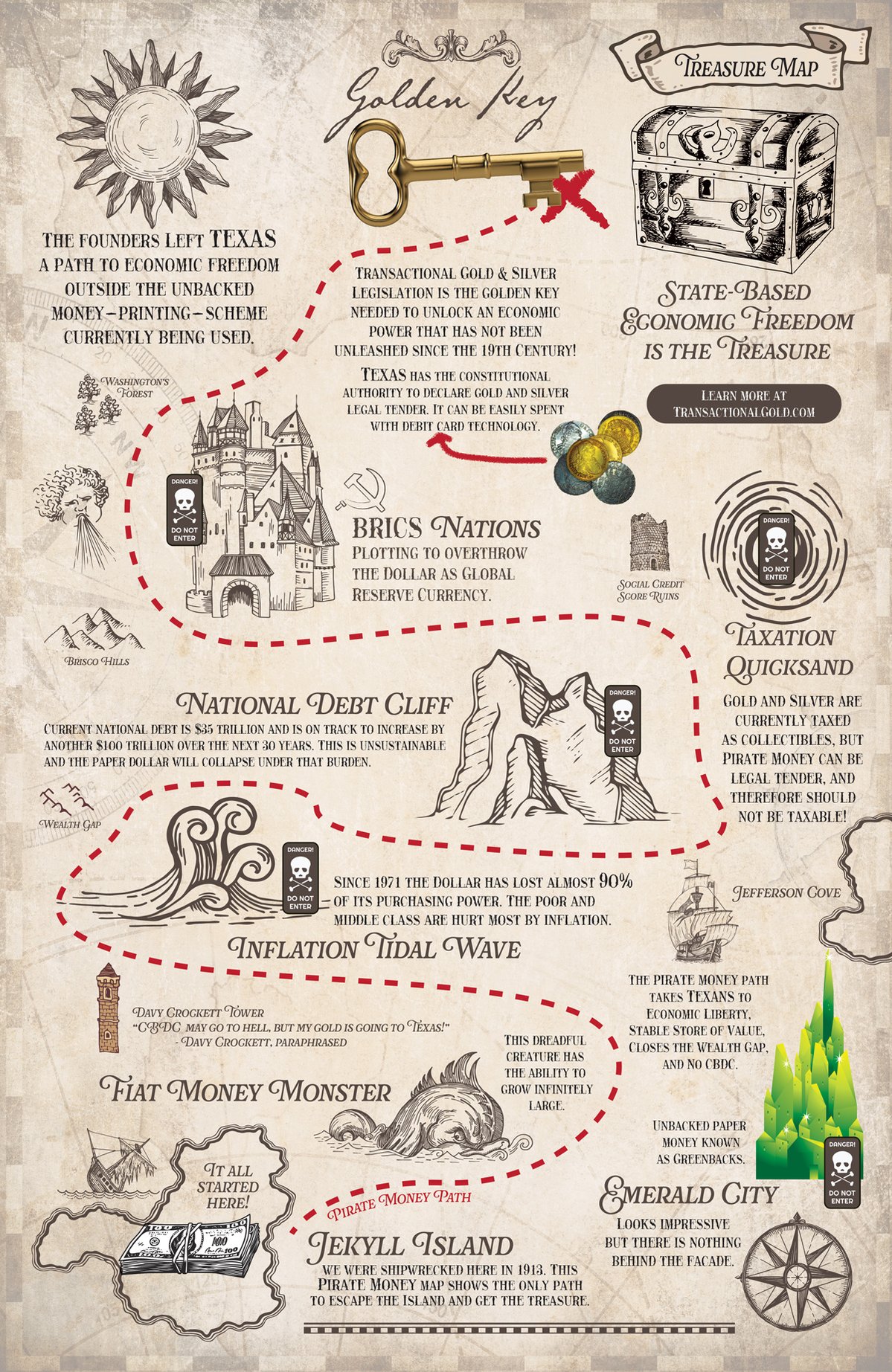
Pirate Money Treasure Map
This Treasure Map is an incredible tool for explaining the history of our monetary problem, and the Transactional Gold and Silver solution!
Download
New to Transactional Gold and Silver? Start here.
The eight questions people ask first, answered in plain language. Each answer links to the full article in the TGS Answer Library.
“Just Another Way to Pay.”
What is Transactional Gold and Silver?
Transactional Gold and Silver (TGS) lets ordinary Americans own real, physical gold and silver and spend it like money. The metal is held in a secure vault within the United States, in your name, and a debit card or app lets you pay for everyday purchases while merchants receive ordinary U.S. dollars. TGS is state legislation that sets the rules; private companies provide the service. It is voluntary, and it is “Just Another Way to Pay.”
Read the full answer → transactionalgold.com/transactional-gold-faqs/what-is-transactional-gold-and-silver
Why do we need Transactional Gold and Silver?
Because the dollar keeps buying less, and ordinary Americans have had no practical way to use gold and silver as everyday money. The U.S. dollar has lost approximately 90% of its purchasing power since 1971, while gold has held its value over time. Transactional Gold and Silver (TGS) is the law that connects the two through a debit card, making that protection official, safeguarded, and available to anyone, not just the wealthy.
Read the full answer → transactionalgold.com/transactional-gold-faqs/why-do-we-need-transactional-gold-and-silver
How does it actually work? How do I spend gold?
You put dollars into a Transactional Gold and Silver (TGS) account, and the provider buys gold or silver for you, measured by weight, so you can start with a small amount. When you pay at the grocery store, the system calculates the exact fraction of gold or silver needed and converts it, and the merchant receives ordinary U.S. dollars. Nothing changes at the register, transactions are seamless and happen at the speed of society today. If you spend your gold, your gold balance simply goes down by the amount you spent.
Read the full answer → transactionalgold.com/transactional-gold-faqs/how-does-a-gold-and-silver-debit-card-work
Who benefits from Transactional Gold and Silver?
Consumers and businesses benefit by having another easy to use payment system. Now gold and silver have easy liquidity and transactional capabilities. Transactional Gold and Silver (TGS) gives ordinary Americans another way to own and use gold and silver, starting with amounts as little as $5. Now, it’s easy to start saving gold and silver or spend it when needed.
Read the full answer → transactionalgold.com/transactional-gold-faqs/who-benefits-from-transactional-gold-and-silver
Is Transactional Gold and Silver legal?
Yes. Article I, Section 10 of the U.S. Constitution says no state may make anything but gold and silver coin a tender in payment of debts, and states can recognize gold and silver as legal tender under their own law. Transactional Gold and Silver (TGS) legislation builds on that foundation. The state sets the legal framework and safeguards, and authorized private providers deliver the service. (Note: The state does not buy the gold or silver, they do not become a bank or have to operate a vault.)
Read the full answer → transactionalgold.com/transactional-gold-faqs/is-transactional-gold-and-silver-legal
Is Transactional Gold and Silver a cryptocurrency?
No to both. Transactional Gold and Silver (TGS) is backed by real, physical gold and silver held in a vault in the United States, not by a digital token on a blockchain. It is not a central bank digital currency either: no central bank issues it, the government does not run the accounts, and nobody is required to use it. The card or app is simply modern payment technology for spending gold and silver you own.
Read the full answer → transactionalgold.com/transactional-gold-faqs/is-transactional-gold-and-silver-cryptocurrency
Does Transactional Gold and Silver replace the U.S. dollar?
No. Transactional Gold and Silver (TGS) adds an option rather than taking one away. You can keep your bank account, cash, and cards, and merchants who accept a TGS payment still receive U.S. dollars. Participation is entirely voluntary for consumers, businesses, merchants, and financial institutions.
Read the full answer → transactionalgold.com/transactional-gold-faqs/is-transactional-gold-and-silver-trying-to-replace-the-dollar
Which states have passed Transactional Gold and Silver laws?
Six states (Texas, Florida, Arkansas, Louisiana, Utah, and Missouri) have enacted Transactional Gold and Silver (TGS) laws, and more states are considering TGS bills.
Read the full answer → New answer, no article yet. Link to be added.
Stay in the Know
Sign up to stay up to date on the latest news in your state?